
Your cart is currently empty!
What is Vertical AI and Why It Matters for Your Industry
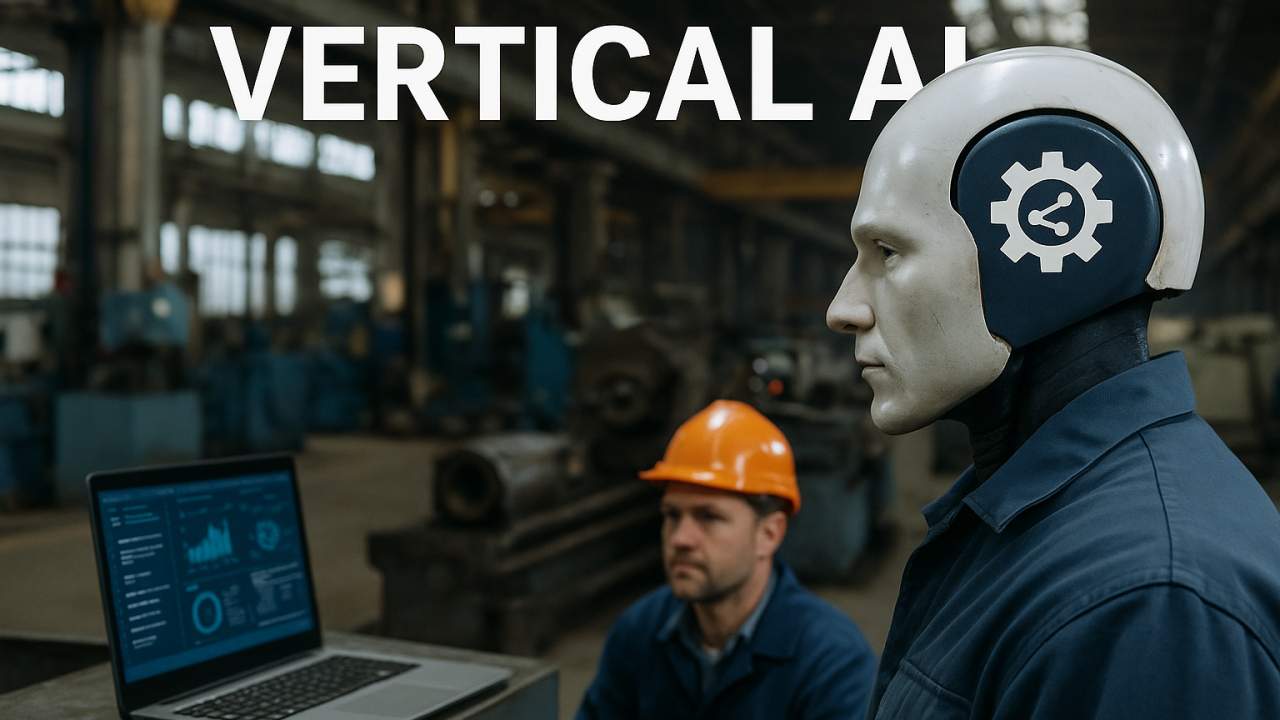

Vertical AI and Industry Applications
This paper examines Vertical AI as an approach which enables traditional industries to apply artificial intelligence to specific operational needs.
This paper also examines how artificial intelligence algorithms can interact and share knowledge with expert workers while demonstrating mutual advantages from their partnership.
What is Vertical AI?
Vertical AI functions as a specialized artificial intelligence framework that serves the requirements of particular industries. The system operates with specific industry support rather than serving as general-purpose intelligence, helping companies within manufacturing, construction, legal, retail, and industrial equipment sectors.
The primary purpose of Vertical AI is to eliminate or assist experienced personnel and enhance operational performance for profit maximization purposes.
To develop Vertical AI you need one crucial component: specific datasets.
Let’s Talk About AI and Datasets
The introduction will explain the basic operation of AI systems before we proceed to Vertical AI analysis.
The Large Language Model (LLM) represents the most widespread and influential form of AI technology in current times, with OpenAI developing ChatGPT as an example. These models link diverse types of information through complex connections known as parameters.
The GPT models developed by OpenAI utilize approximately 1.8 trillion parameters for their operations. The number of parameters within a model determines its intelligence and operational capabilities.
How do you develop a model in this manner? The answer: datasets.
An algorithm requires specific information to develop its training data through the dataset. The AI system processes data to detect patterns, enabling the generation of an understanding model that answers queries in an organized manner.
The accuracy and intelligence of the final AI model increases proportionally with the variety and range of datasets used.
From Which Sources Do These Datasets Originate?
OpenAI keeps the origins of their datasets private, although researchers believe they aggregate multiple terabyte datasets spanning various knowledge domains.
OpenAI experts claim their models train on digital books and all public internet pages in a manner similar to how Google indexes web pages. The models continuously expand their knowledge by learning from fresh data — potentially including this article you are currently reading.
Why Datasets Are So Valuable
A powerful AI model requires datasets as its essential foundation for development. This asset stands as a distinct valuable resource. Companies that gain better access to high-quality industry-specific data will produce AI models that are more precise and useful.
We will now return to the discussion of Vertical AI.
Vertical AI = Industry Specific Intelligence
Vertical AI implies transforming AI systems to function according to industry-specific knowledge requirements. Specialized datasets are necessary for each industry sector such as construction, law, consumer retail, and industrial sales.
A dataset should include texts, procedures, schemas, prompts, images, videos, and additional forms of organized and unorganized information. Training models through this data allows them to develop a profound understanding of real-world business operations.
The analysis capabilities of large models such as GPT remain effective for summary tasks but face boundaries when dealing with specialized and unique domain-specific inquiries. Vertical AI becomes essential at this point.
A Real Example: Surplus Equipment Business
Your company focuses on used industrial equipment sales to customers.
A technician who has worked for more than twenty years can evaluate the state of equipment through instant assessment of its condition, ranging from excellent to fair or nonfunctional.
AI systems lack the ability to execute this assessment effectively, particularly when dealing with specialized equipment beyond basic consumer electronics.
The technician’s role extends past basic visual checks, requiring them to determine equipment problems and locate absent parts through extensive practical experience. Such deep industry-specific expertise remains difficult for general AI models to duplicate due to a lack of proprietary datasets containing specialized knowledge.
Training Each Other: AI and Humans in a Loop
So here’s how the process should work:
- Skilled professionals provide their industry knowledge to the AI system to teach it industrial operations.
- The AI system then supports novice employees by demonstrating proper procedures, preventing errors, and enhancing operational performance.
This is a feedback loop where humans train AI — and AI trains humans back.
The Future of Vertical AI
The main concept revolves around the ongoing development of AI solutions that meet the specific requirements of particular sectors. The integration of real-world experience into AI systems will result in better delivery of valuable results.
Vertical AI represents the upcoming work paradigm where AI develops into a dependable assistant for experts in different industries.
About the Author: Andrei Klimanov
Andrew is the co-founder and CEO at REUZEit Technologies, the Next Gen Circularity Platform, a new spin-out from REUZEit Surplus Asset Management.
Leave a Reply